A Professional's Take on the New Framework Laptop 16 2025
Introduction
The Framework Laptop 16 2025 arrives in a market that increasingly values longevity, repairability, and real-world adaptability as much as raw performance. For professionals who treat a laptop as an investment — developers, content creators, systems administrators, and small-business owners — the 16-inch model positions itself as an alternative to sealed, monolithic designs by doubling down on modularity and serviceability. This article examines the Framework Laptop 16 2025 from a pragmatic, professional perspective: what it does well, where it compromises, and how it fits into typical real-world workflows.
Product overview
The Framework Laptop 16 2025 builds on the company’s core philosophy: a laptop whose key components are user-replaceable and upgradeable. Rather than focusing solely on the thinnest chassis or the highest synthetic benchmark, Framework continues to prioritize a repair-first design that allows owners to replace or upgrade storage, memory, batteries, wireless modules, and other subsystems with relative ease.
For buyers who prioritize long-term ownership, the value proposition is clear: lower total cost of ownership over several years, reduced electronic waste, and the flexibility to evolve a machine as needs change. The 16-inch size targets professionals who want a larger screen for multitasking and content work without moving up to a heavier mobile workstation.
Design and build quality
On first impressions, the Framework Laptop 16 2025 maintains a sober, businesslike aesthetic. The chassis favors durability and repair access over extreme thinness. The laptop feels solid on a desk and uses materials chosen for longevity rather than fashion-forward finishes. Hinges are designed to minimize wobble while offering a wide opening angle, which professionals appreciate when docking into multi-monitor setups or presenting in small meeting rooms.
Key design points that matter to professionals:
- Serviceability: Panels and modules are accessible with common tools; internal components are labeled and modular.
- Thermal layout: The chassis provides room for cooling compared with ultra-thin alternatives, which helps sustain performance under prolonged workloads.
- Keyboard and trackpad: The typing experience is tuned for long sessions — key travel is moderate and feedback is consistent. The trackpad is large enough for multi-finger gestures and accurate enough for productivity tasks.
Display and multimedia
The 16-inch display is the centerpiece for many buyers: a larger canvas makes spreadsheets, timelines, and code editors easier to work in without constant window switching. Framework’s display aims for a balance of color accuracy and power efficiency — adequate for photo editing, video review, and general content creation. Professionals who require absolute color-critical work should still calibrate the panel or opt for an external, color-calibrated monitor when needed.
Speakers are serviceable for conference calls and casual media consumption but are not a substitute for a dedicated audio setup during client-facing work where audio fidelity matters. Webcam and microphone quality are appropriate for business meetings and remote collaboration; however, professionals who frequently produce high-quality video content will likely prefer external microphones and webcams for studio-grade results.
Performance and thermals
Framework’s 16-inch chassis trades some thinness for better thermals and sustained performance. In everyday professional use — compiling code, running virtual machines, editing high-resolution photos, and managing multiple browser tabs and productivity apps — the machine behaves predictably. Thermal headroom reduces the frequency of thermal throttling under sustained CPU/GPU loads compared with ultra-thin designs.
Performance is ultimately tied to configuration choices. Framework’s modular nature lets buyers prioritize more RAM and larger local storage if workloads demand it, which is valuable for developers and content professionals who rely on local build caches, virtual machines, or large media libraries.
Internal modularity and upgrade path
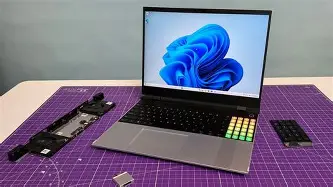
Where the Framework Laptop 16 2025 is most distinctive is its internal architecture. Components that are typically soldered on other laptops are user-replaceable here, making upgrades and repairs straightforward. Relevant aspects include:
Find top-rated Laptops & Computers products at great prices.
View Offers →- Memory and storage: Upgradable and replaceable — buyers can install more RAM or swap SSDs as needs change.
- Battery accessibility: Designed to be replaceable with common tools, extending usable life beyond typical non-serviceable machines.
- Wireless and I/O modules: Replaceable modules mean one can upgrade Wi‑Fi or add different I/O without replacing the entire laptop.
For businesses that manage fleets, or individuals who want to keep a single machine for many years, these design choices reduce the friction of lifecycle upgrades and repairs. This model supports a practical approach: refresh the part that needs to be refreshed rather than recycling an otherwise serviceable device.
Ports and expandability
Professionals often care more about port availability than ultra-thinness. The Framework Laptop 16 2025 recognizes this by offering a mix of ports and modular expansion. The availability of full-sized ports or modular expansion slots makes connecting external monitors, storage arrays, card readers, and peripherals more convenient without relying on dongles.
Key considerations:
- Docks and adapters: While docks remain useful for multi-monitor desks, users will find fewer day-to-day interruptions when common ports are built into the chassis.
- Hot-swappable expansion: The modular approach reduces the need to carry a bag of adapters and simplifies switching peripherals during client visits or co-working days.
Battery life in real-world use
Battery life is workload-dependent. For knowledge workers running text editors, web conferencing, and spreadsheets, the 16-inch Framework typically delivers a full workday of use. For creators running editors, rendering tasks, or prolonged local compilation, battery life will be shorter and users should plan for access to power depending on workload intensity.
Because the battery is user-replaceable, professionals who expect to travel extensively can carry a spare or swap batteries after extended periods of heavy use, an option rarely available with sealed designs.
Security, manageability, and support
Framework keeps parity with business expectations for manageability: support for disk encryption and standard platform security features are present, and the modular hardware lends itself to easier device servicing. For managed fleets, the combination of repairability and documented disassembly can reduce downtime and simplify IT procedures. Buyers should verify enterprise-level support and warranty options with their reseller or directly with Framework when making procurement decisions.
Real-world use cases
How does this laptop fit into professionals’ lives? A few representative scenarios illustrate its strengths:
- Software development: Developers appreciate the ease of upgrading RAM and storage. Local VMs and containerized workloads benefit from additional memory and faster NVMe storage options. If a Wi‑Fi module fails while traveling, swapping it out is quicker than ship-to-repair cycles.
- Content editing and design: A 16-inch display reduces dependence on external displays for in-studio editing. Upgrading storage and keeping external color-calibrated monitors provides a practical setup for freelancers and in-house creatives.
- Field engineering and IT support: Repairability reduces downtime. Technicians can replace a battery, swap out a failing SSD, or upgrade Wi‑Fi modules onsite, which is valuable for distributed teams.
- Small business ownership: The ability to reuse chassis across component refreshes lowers total lifecycle costs and supports conservative upgrade cycles for limited IT budgets.
Pros & Cons
Pros
- Modular, repair-first design that extends useful life and reduces e-waste.
- Accessible internals for upgrades — memory, storage, battery, and connectivity modules.
- Comfortable 16-inch workspace suitable for multitasking and creative tasks.
- Thermal headroom compared with many ultrathin laptops, enabling steadier sustained performance.
- Practical port selection and expansion options for professionals who dislike dongles.
- Lower long-term ownership costs for users who plan to maintain and upgrade their machine.
Cons
- Not the lightest or thinnest 16-inch option on the market; trade-offs favor serviceability over minimal weight.
- For users seeking out-of-the-box color-critical displays or studio-grade audio, external peripherals may still be required.
- Some mainstream buyers may prefer turnkey devices with longer vendor-managed upgrade programs or enterprise-level warranties.
- Initial configuration choices matter; choosing underpowered components will limit performance until upgraded.
Comparison table
The following table compares qualitative attributes of the Framework Laptop 16 2025 with two common alternatives professionals evaluate: a typical premium ultraportable 16-inch machine and a mainstream workstation-style 16-inch laptop. The table uses high-level, comparative descriptors rather than specific model names.
| Attribute | Framework Laptop 16 (2025) | Premium Ultraportable 16-inch | Mainstream 16-inch Workstation |
|---|---|---|---|
| Repairability / Upgradability | Very high — user-replaceable modules | Low — many components soldered | Moderate — some components serviceable by technicians |
| Weight / Portability | Moderate — balance of sturdiness and mobility | Low weight — optimized for travel | Heavier — built for performance and expandability |
| Thermals / Sustained performance | Good — designed with headroom | Variable — may throttle under sustained load | Very good — robust cooling for long tasks |
| Display options | Good — balanced for productivity and content | Excellent — high-res, color-accurate panels available | Good — often available with workstation-grade panels |
| Ports / Expandability | Strong — modular ports and practical selection | Limited — relies on dongles/docks | Strong — many legacy and modern ports |
| Total cost of ownership | Lower long-term (if upgraded/maintained) | Higher — replacement often required after a few years | Higher upfront; lifecycle varies by vendor support |
Buying guide: what professionals should consider
Choosing a Framework Laptop 16 2025 should be driven by use case, upgrade expectations, and service preferences. The following guide helps professionals align configuration choices with real-world needs.
1. Define the primary workload
If the laptop is expected to run virtual machines, local containers, or large spreadsheets, prioritize buying or later installing more memory and faster internal storage. For primarily web-based workflows, a mid-tier RAM and SSD configuration will suffice and can be upgraded later if required.
Shop the latest Laptops & Computers picks on Amazon.
Browse Now →2. Prioritize serviceability if long-term ownership matters
One of Framework’s strongest selling points is ease of repair. If the purchase horizon is three to five years (or longer), favor configurations that are easy for the buyer or IT team to maintain. Factor in the explicit ability to replace batteries, storage, and wireless cards as a cost-saving benefit.
3. Evaluate port needs before assuming docks
Professionals who frequently plug in external displays, wired networking, SD cards, and multiple USB accessories should evaluate the laptop’s onboard ports. Framework’s modular ports reduce the need to carry many adapters, which simplifies travel and client visits.
4. Consider display requirements
For color-sensitive work, plan for calibration or an external reference monitor. The built-in 16-inch display is flexible for general creative work but should be validated against professional color workflows if exact color reproduction is critical to the job.
5. Plan for warranty and support expectations
Businesses that manage multiple devices should confirm available warranty terms and business support plans. Modular hardware simplifies in-house repairs, but enterprise buyers may still prefer vendor-assisted service agreements. Consider the trade-offs between self-service and vendor-managed support when budgeting total cost of ownership.
6. Budget for peripherals where needed
Items such as external microphones, color-calibrated monitors, and docks may still be useful. Factor these into the overall procurement budget rather than expecting a single laptop to serve every need with no accessories.
Final considerations
Framework’s approach with the 16-inch model targets a clear audience: professionals who value a long-term, adaptable computing platform over the shortest possible chassis or the highest immediate benchmark scores. It rewards owners who are willing to think in terms of lifecycle management — upgrading parts, repairing failures quickly, and customizing hardware to evolving needs.
From a sustainability perspective, the design aligns with corporate and individual initiatives to reduce electronic waste and extend hardware lifetimes. For IT teams in small and medium businesses, the ability to perform routine repairs in-house can translate to faster turnaround, lower shipping costs, and reduced downtime.
Conclusion
The Framework Laptop 16 2025 is a considered choice for professionals who prioritize repairability, upgradability, and practical day-to-day ergonomics. It does not chase ultra-thin form factors or attempt to be everything to everyone; instead, it presents a coherent value proposition for those who view a laptop as a long-term, serviceable tool. For buyers whose workflows demand flexibility and who plan to keep and maintain their machines, the 16 2025 offers tangible advantages. For users who prioritize the absolute lightest weight or the most out-of-the-box color accuracy, pairing the laptop with external peripherals or choosing a different class of machine may be more appropriate.