Don't Buy the Thermal Master P1 Mobile Thermal Camera Until You Read This Full Analysis
Thermal imaging has moved from specialized professional equipment into the hands of hobbyists, contractors, and homeowners through compact, mobile thermal cameras. The Thermal Master P1 Mobile Thermal Camera is one of the newer entrants aimed at users who want a pocketable thermal tool that pairs with a phone or works standalone. Before making a purchase, potential buyers should understand how the P1 performs in real-world tasks, where it excels, and where its limitations are most likely to affect outcomes.
Introduction: who this camera is for and why it matters
Thermal cameras are used for a wide range of practical tasks: diagnosing HVAC failures, locating insulation gaps, spotting electrical hot spots, checking for water intrusion, and even outdoor navigation or wildlife observation in low light. Buyers typically care about image clarity, sensitivity (the camera’s ability to show small temperature differences), ease of use, connectivity, battery life, and software features like image blending, measurement tools, and export options.
This analysis looks at the Thermal Master P1 in the context of those needs. It separates marketing claims from practical performance, examines fit-for-purpose use cases, compares the P1 to common alternatives, and provides a buying guide so readers can decide whether the P1 matches their priorities and budget.
Detailed product review and analysis
Design and build quality
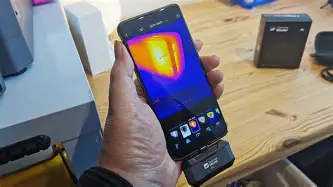
The Thermal Master P1 is designed to be portable: compact, lightweight, and either a plug-in module for mobile devices or a small standalone unit depending on the SKU. The casing is typically plastic with a textured finish for grip. The physical controls are minimal, geared toward a mobile-first workflow where most configuration happens in an app. For users who prefer tactile controls, this software-centric approach can be limiting; for those who value compactness, it is an effective trade-off.
Image quality and sensor performance
Thermal image quality determines how useful a camera is for diagnostic tasks. Image clarity depends on sensor resolution, optics, and thermal sensitivity (NETD). In practice, the P1 delivers images that are adequate for general home inspection, hobbyist troubleshooting, and casual outdoor use—but not comparable to high-end radiometric handhelds used by professional thermographers.
Strengths in the P1’s imaging include clear thermal palettes, visible hot/cold differentiation in common scenarios (e.g., electrical panels, heating ducts), and decent edge detection in mid-range scenes. Weaknesses show up under finer inspection: small thermal gradients, tiny hot spots on circuit boards, and long-distance detection will be harder to interpret than with higher-resolution cameras. Users who must document subtle thermal differences for contract work or compliance will find the P1’s images limiting without supplementary context.
Software, user interface, and measurement tools
A mobile app is central to the P1 experience. The app provides live thermal view, color palettes, spot temperature readouts, isotherm highlights, and temperature histograms. It usually supports capturing combined visual + thermal snapshots and basic annotations.
Practical observations about software behavior are important: the best thermal workflows rely on reliable, fast app connections, stable video streaming, and straightforward export of radiometric data (or at least temperature-annotated images). The P1 app typically handles the common tasks smoothly, but the app ecosystem around mobile thermal modules can be inconsistent — updates, phone compatibility, and export capabilities vary. Buyers should confirm whether the app supports the exact phone model and operating system version in use and whether the export format meets reporting needs.
Connectivity and compatibility
Manufacturers usually offer P1 variants for USB-C, Lightning, or Bluetooth/Wi‑Fi connectivity. The plug-in modules are convenient for on-the-go inspection with a smartphone; standalone models add convenience but increase size and complexity. Thermal Master’s offerings aim to support mainstream phones, but compatibility should be checked against the buyer’s specific device and OS version.
Battery life and portability
If the P1 relies on the host phone for power (plug-in module), battery life depends on the phone’s remaining charge and the efficiency of the connection. Standalone P1 units include a built-in battery with runtime sufficient for short inspection sessions, but heavy continuous streaming will deplete it faster. For contractors who need several hours of inspection, a power strategy (spare battery, power bank, or intermittent use) is practical to plan in advance.
Find top-rated Cameras & Photography products at great prices.
See Deals →Real-world use cases
Home inspectors and DIYers will appreciate the P1 for quickly scanning walls, electrical panels, and plumbing runs. It helps identify obvious insulation gaps, leaky windows, and active leaks when paired with visual clues. For HVAC techs or electricians doing cursory diagnostics, the P1 can point to problem areas but might require a higher-grade camera for final verification.
For outdoor and recreational users — hikers, campers, and wildlife observers — the P1 provides added situational awareness in low light. Hunters or nature watchers should remember that consumer thermal cameras are not a substitute for specialized night-vision or thermal optics used for long-range observation.
Professional thermographers or facility maintenance teams that must produce evidence-grade thermal reports or detect subtle anomalies in electronics will likely find that the P1 is a convenient secondary tool but not a primary instrument for critical inspections.
Pros & Cons
- Pros
- Portable and pocket-friendly design suitable for quick inspections on the go.
- Mobile-first workflow with intuitive app controls for immediate results.
- Useful for broad searches: finding insulation gaps, active leaks, and obvious electrical hot spots.
- Lower price point than professional industrial thermal cameras, offering good value for non-specialists.
- Multiple palette options and straightforward spot-temperature readouts for everyday tasks.
- Cons
- Sensor and image resolution are mid-range—limited ability to resolve very small hotspots or fine gradients.
- Software/export capabilities vary by model and app version; radiometric exports may not be available on all SKUs.
- Battery and streaming performance depend on model and phone; continuous use can drain devices quickly.
- Not a replacement for professional-grade thermal cameras where measurement precision and certification matter.
- Long-distance detection and small-electronics inspection show the limits of the sensor.
Comparison: Thermal Master P1 vs common alternatives
The following table compares the Thermal Master P1 qualitatively with two broadly available competitors that buyers often consider when shopping for mobile thermal cameras. This comparison focuses on practical differences buyers care about rather than marketing jargon.
| Feature | Thermal Master P1 | Common Mobile Module A (example competitor) | Common Mobile Module B (example competitor) |
|---|---|---|---|
| Intended user | DIYers, homeowners, light contractors | Entry-level DIY and hobbyists | Serious prosumers and light professionals |
| Image clarity | Mid-range; adequate for broad diagnostics | Lower; best for coarse spotting | Higher; better detail and small-spot detection |
| Sensitivity and subtle gradient detection | Good for everyday use, not for tiny gradients | Limited; mostly surface-level differences | Better NETD and contrast for finer work |
| Software features | Standard palettes, spot meters, basic annotations | Basic app, limited export | Advanced app options, better reporting/export formats |
| Connectivity | Phone module and standalone options (varies) | Phone module only | Standalone units plus phone connectivity |
| Price category | Mid-budget | Budget | Mid- to higher-end |
| Best fit | Quick inspections, home checks, outdoor use | Casual spotting, novelty use | Contract work, formal reporting, detailed troubleshooting |
Buying guide: what to evaluate before purchasing the Thermal Master P1
1. Define the primary use case
Start with what problems the camera should solve. For occasional home energy checks, leak detection, or safety scans, a mid-range mobile thermal camera like the P1 can be a cost-effective choice. If the buyer needs to produce evidence for reports, perform precision electrical diagnostics, or inspect small electronic components, a higher-end radiometric camera is a better investment.
2. Check sensor and image characteristics
Pay attention to:
- Thermal resolution — higher resolution delivers clearer images and more usable detail for small objects.
- NETD / sensitivity — lower NETD values indicate the camera can detect smaller temperature differences; this is essential for subtle diagnostics.
- Field of view (FOV) — wider FOV captures more context, but narrower FOV helps focus on small targets at distance.
- Frame rate — higher frame rates produce smoother live views, which matter for dynamic scenes.
Manufacturers sometimes quote marketing numbers; buyers should review sample images and independent tests when available.
3. Evaluate software and export functionality
Software dictates how easily the user captures, annotates, and shares findings. Key items to verify:
- Does the app provide spot temperature, area min/max, and isotherm tools?
- Are radiometric exports (temperature per pixel) available if required for reporting?
- How stable is the app across iOS and Android versions?
- Does the app allow side-by-side visual + thermal capture and simple annotations?
4. Confirm compatibility with devices and workflows
If the P1 is a phone-module variant, confirm physical compatibility (USB-C vs Lightning) and software support for the buyer’s phone model. If the buyer uses tablets, check that the app supports larger screens. For teams, consider whether images can be synced to cloud storage or exported in batch.
Discover deals on Cameras & Photography — updated daily.
Browse Now →5. Consider the warranty and support
Thermal cameras are precision instruments and benefits from reliable customer service and a reasonable warranty. Buyers who will use the camera for professional tasks should prioritize vendors who offer repairs or sensor calibration services.
6. Plan for power and accessories
Think about spare batteries, protective cases, and whether a tripod or lens protector is necessary for the intended tasks. Accessories can extend the camera’s usefulness, especially if inspections are frequent or in challenging environments.
Price vs value: realistic expectations
The Thermal Master P1 positions itself as a value-oriented tool for buyers who want thermal capability without the professional price tag. That positioning is sensible: for non-critical, visual-first tasks the P1 often delivers useful results for a fraction of the cost of industrial-grade units. However, value depends on expectations — if the buyer expects professional accuracy, detailed reporting, or pixel-level thermal data, the P1 is not a substitute for certified thermal imaging equipment.
Practical tips for getting the most from the P1
- Use the camera at close to mid-range distances for best detail; move physically closer to small targets rather than relying on digital zoom.
- Capture a visual photo alongside every thermal image to provide context during later review.
- Allow the camera to acclimate to ambient temperature when moving between extreme environments to avoid temporary measurement skew.
- Use multiple color palettes to reveal different features — one palette may show fine gradients better than another.
- Validate suspicious readings with a contact thermometer when safety or liability is involved (electrical diagnostics, gas leaks, medical concerns).
Common buyer questions and quick answers
Can the P1 detect overheating in outlets and breakers?
Yes — the P1 can identify obvious hot spots in panels and outlets. For definitive failure analysis and safety-critical documentation, a higher-resolution or calibrated device is recommended.
Is it suitable for inspecting small electronics?
Not ideally. Small circuit board components generate fine thermal gradients that require higher resolution and sensitivity than most mid-range mobile cameras provide.
Does the app save temperature data per pixel (radiometric files)?
This varies by model and firmware. Buyers who need radiometric data should verify the specific P1 variant supports that export before purchasing.
Conclusion
The Thermal Master P1 Mobile Thermal Camera is a sensible choice for buyers who want a portable, easy-to-use thermal tool for home inspections, HVAC checks, and general-purpose troubleshooting. It brings thermal imaging within reach of DIYers and occasional users by focusing on portability and app-driven workflows. However, it is important to match expectations to capabilities: the P1 offers mid-range imaging that is excellent for broad searches and obvious anomalies but limited when it comes to fine-detail detection, certified measurements, or professional reporting.
Before buying, potential purchasers should clearly identify their primary use cases, verify compatibility with their devices, confirm the app’s export and reporting features, and consider whether investment in a higher-grade camera is warranted for professional needs. Armed with that information, buyers can decide whether the P1 is the right tool for their toolbox — or whether it should be a convenient complement to more specialized equipment.